News for 18 May 2018
All the news for Friday 18 May 2018
Indian women enter final
Asian Champions Trophy Defending champs beat Malaysia 3-2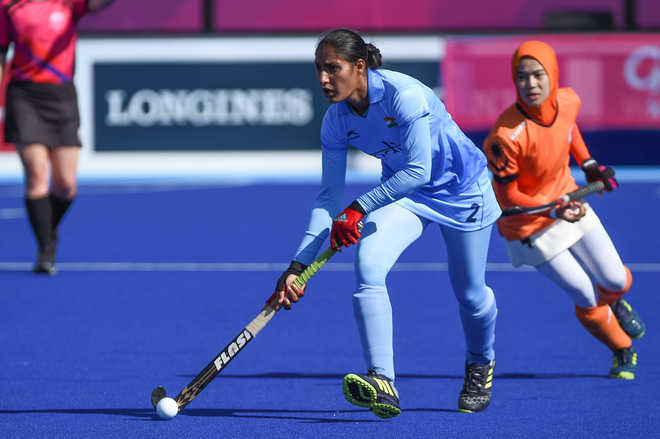
Drag-flicker Gurjit Kaur scored India’s opening goal. File
Defending champions India qualified for the summit clash of the women’s Asian Champions Trophy after edging past Malaysia 3-2 on Thursday. India, who beat Japan 4-1 and China 3-1 in their previous matches, sealed a spot in the final with a match in hand in the pool stage. They are sitting atop the table with nine points and will next take on hosts South Korea on Saturday in what would be a rehearsal for Sunday’s final.
South Korea beat China 3-1 in the other match on Thursday, taking their tally to seven points. They are second on the table, with third-placed China four points behind with one game to play.
Fast start
India had beaten Malaysia 6-0 in a warm-up match before the tournament, and it seemed India were going for a repeat with their attacking start. They earned a penalty corner in the very first minute, but Malaysia denied drag-flicker Gurjit Kaur.
India got the breakthrough when Gurjit converted a penalty corner in the 17th minute. She found the bottom right corner to get her second goal in two matches.
India did not look their attacking best. However, the halftime break helped India regroup. They defended more aggressively and the high press worked as India scored in the 33rd minute. Vandana Katariya intercepted a pass in the Malaysian circle before finishing with a reverse strike to get her third goal of the tournament. For the third match in a row, India went 2-0 up.
But their two-goal lead didn’t last very long. Three minutes later, India conceded a penalty stroke when defender Deep Grace caused an infringement while attempting to stop a Malaysian attacker from taking a shot on goal. Nuraini Rashid converted the penalty stroke.
The following minutes saw India win as many as three PCs but could not make much of it. India, though, regained their two-goal lead in the 40th minute. A brilliant long pass by skipper Sunita Lakra was deflected in by young forward Lalremsiami.
Malaysia, who had earlier upset Japan 3-2, fought back into the match with a 48th-minute goal from Hanis Onn, but India hung in to take the three points.
The Tribune
Malaysian women give India a fright
By Jugjet Singh
KUALA LUMPUR: The Malaysian women's team gave India a run for their money before losing 3-2 in the Asian Champions Trophy (ACT) in Donghae, South Korea, Thursday.
Now, they will have to wait for the China-Japan match Saturday to see if they have a chance of playing in the third-fourth bracket.
The ACT is played in a pool of five teams, and Malaysia has three points as they had beaten Japan 3-2.
Japan are at the bottom of the pool with only one point.
Yesterday, Gurjit Kaur (17th), Vandana Katariya (33rd) and Lalremsiami (40th) scored for India, and Malaysia's super fight-back came from Nuraini Rashid (36th) and Hanis Nadiah Onn (48th)
For the record, Malaysia are ranked 22nd in the world while India are number 10th.
"We went into the match knowing India's strength and had to rely on counter-attacks to trouble them. And I am proud to say that we did cut down their domination for long periods in the match.
"Now, we have to wait for the China-Japan match (today) to see if we will be playing in the third-fourth or end fifth in this tournament.
"And we have a good chance to play in the higher bracket, because it wil not be easy for Japan to beat China."
Jugjet's World of Field Hockey
Malaysia's women’s squad go down to India in ACT
KUALA LUMPUR: The national women’s hockey team took the fight to defending champions India before going down 2-3 in the Asian Champions Trophy (ACT) in Donghae, South Korea.
They will have to wait for the match between China and Japan tomorrow to see if they have a chance of playing in the third-fourth classification game in the five-team competition.
Malaysia are fourth in the standings after a 3-2 upset win over Japan on Wednesday, following defeats to South Korea (1-3) and China (1-3). Japan are bottom with one point.
India scored through Gurjit Kaur (17th), Vandana Katariya (33rd) and Lalrem Siami (40th) while Nuraini Rashid (36th) and Hanis Nadiah Onn (48th) responded for Malaysia.
Malaysia are only ranked 22nd in the world while India are 10th.
Malaysian Hockey Confederation president Datuk Subahan Kamal is happy with the performance of the women’s national team.
“Our women’s team used to get thrashed by the top sides but they have shown they can be competitive now.
“They ensured Malaysia will not finish last by beating Japan,” said Subahan, adding that Malaysia have a good chance to play for third place as it will not be easy for Japan to beat China.
The Star of Malaysia
Newbie Lulu Tuilotolava taking one step at the time for the Black Sticks
OLIVIA CALDWELL
Auckland striker Lulu Tuilotolava was named in the Black Sticks this week to play in the tri series against Australia and Japan in Cromwell this week.
What a time to be called in to the Black Sticks.
A month ago they won gold at the Commonwealth Games, four months after they overtook Australia in the world rankings for the first time to sit in fourth place.
Roll in Auckland's Lulu Tuilotolava who will make her debut against Japan in Cromwell, Central Otago, on Saturday.
Lulu Tuilotolava in Cromwell this week for her debut with the Black Sticks.
The 21-year-old was shocked when she was called in to the side as she was only "filling in" for the development squad.
Coach Mark Hager must have had a different idea for the fast midfielder/striker, calling her into the squad named this week.
"It was a surprise for me. It's so exciting," Tuilotolava said.
Tuilotolava first picked up a hockey stick when she was five and over the last few years modelled her own game off her favourite Black Stick, Auckland midfielder Liz Thompson.
Thompson won't be available for the series against both Australia and Japan (ranked 12th), but Tuilotolava was given advice by the veteran.
"She said just to play my natural game and just enjoy it," she said.
"It's good for me because I am still learning, so it is good to have these girls around and teaching me as well."
Each team will play each other twice during a round robin phase, with the top seed automatically progressing to the final to play the winner of a second vs third playoff.
Keeping a level head, Tuilotolava isn't looking any further than her first match in the black dress. The nerves are yet to kick in.
"I haven't quite thought about it yet, I will give it time to sink in. I bet I won't sleep. Then tomorrow when I put on the uniform I probably will be excited."
The Black Sticks head to London at the end of July to play in the UK's biggest women's only sporting event, where already 100,000 tickets have been sold.
After that the 2020 Tokyo Olympics is another big opportunity that could await her, if she performs in Cromwell.
"It is something I want to be part of but it's not something I think about too much. It will be one step at a time, each game at a time and keep learning. That's a long-term goal that i'll try and achieve, but it'll just be the little steps to get there."
Aside from hockey Tuilotolava is studying a bachelor in communications at Massey University with the aim of becoming a sports journalist.
Tuilotolava was playing club hockey during the breathtaking gold medal final against Australia, but said watching the replay gave her hunger to be a part of the side. Now selected she realises there is a long way to go before becoming a household name.
"I'll probably be the one to carry the hockey balls or the team drink bottles."
Five gold medal winners haven't been included in the series with captain Stacey Michelsen, Sam Charlton, Thompson and Amy Robinson injured and Pippa Hayward retired. .
This has left room for Kirsten Pearce and Michaela Curtis, with defenders Steph Dickins and Kim Tanner returning.
Assistant coach Sean Dancer will take on head coaching duties this week.
New Zealand play Japan on Saturday at 4:30pm.
Stuff
MHC keen to host both World Cups in 2022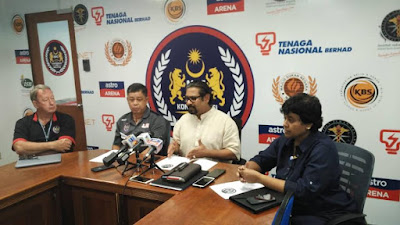
From Left: Terry Walsh, Stephen van Huizen, Subahan Kamal, Shamala.
KUALA LUMPUR: Malaysia are keen to host the 2022 men's and women's hockey World Cups.
This was revealed by Malaysian Hockey Confederation (MHC) president Datuk Seri Subahan Kamal Thursday.
Subahan said the confidence to bid arose because the International Hockey Federation (FIH) approached Malaysia to host the final of the Hockey Series, which is a qualifier for the 2020 Tokyo Olympics.
"I will meet members of the MHC Executive Board soon to get their approval to host the Hockey Series finals in Kuala Lumpur next year.
"And I will also put forward to the EB the idea to host both the men's and women's World Cups which will be held in 2022.
"I have spoken to Terry Walsh (Technical Director) on these matters, and if the EB approves, we will officially write to the FIH on our intention to host both the World Cups."
Malaysia last hosted the men's World Cup in 2002 and finished eighth among 16 teams.
"And if this plan becomes a reality, our women will experience playing in the World Cup for the first time.
"I believe Malaysia will have no problems hosting both the World Cups, and I also believe our men's and women's teams will be ready to put up a good challenge by then," said Subahan.
Meanwhile, national coach Stephen van Huizen yesterday released the names of 20 players who would head for Argentina to play in a series of friendlies on May 25-June 2.
Van Huizen included No 1 goalkeeper S. Kuamar who has served his six months FIH ban for being tested positive with sibutramine during the Asia Cup in Dhaka last year.
"Kumar has been training very hard since the ban was lifted, and that's one of the reasons I believe he should be given a chance to play in the Argentina friendlies," said van Huzien.
Jugjet's World of Field Hockey
Veteran keeper Kumar to play in Tour of Argentina
KUALA LUMPUR: Goalkeeper S. Kumar, who recently served out a six-month doping suspension, has been included in the national men’s hockey squad for the Tour of Argentina.
The team will leave for Buenos Aires on Monday where they will play six friendly matches against Rio Olympic champions Argentina.
The Malaysian Hockey Confederation (MHC) announced a list of 20 players for the tour from May 24 to June 1 as part of preparations to challenge for gold at the Indonesia Asian Games in August.
Kumar failed a doping test during the Asia Cup in Dhaka, Bangladesh, last October when a small amount of sibutramine – prohibited by the World Anti Doping Agency (Wada) – was found in his urine sample.
Malaysia lost to India 1-2 in the final of the Asia Cup, which was their best performance before Kumar was banned.
Once rated as the No. 1 goalkeeper in Asia, Kumar did not play in the recent Azlan Shah Cup and Commonwealth Games in Gold Coast, where Malaysia finished fourth and fifth respectively.
MHC president Datuk Subahan Kamal said it is good to see Kumar back in the national team and one of the two goalkeepers selected.
“He has been training hard the last few weeks and has shown he’s one of the better goalkeepers.
“The players are confident around him. These matches (in Argentina) will be important to him as we hope he can help us for the Asian Games mission,” said Subahan, adding that two players – Muhd Firhan Ashari and Ramadhan Rosli – were left out due to injuries.
The absence of the duo paved the way for Muhammad Haziq Samsul and Muhammad Najib Abu Hassan to make their national team debuts.
Subahan also added the MHC have received an offer to host the Hockey Series World Finals in June next year.
“We plan to do it at the National Hockey Stadium in Bukit Jalil and it will be another route to the Tokyo Olympics for us.
“The Asian Games is the first option to qualify for the Olympics but we need to win it.
“There is now a second option by finishing in the top two and we’re keen to do it.
“MHC are also interested in hosting the 2022 World Cup for men and women.
“Our national men’s team can compete with any top team in the world while I believe our women’s side will be competitive by then.
“However, any final decision to go ahead will depend on the support from the state exco members.
“We will have our MHF exco meeting on June 2 to discuss this,” he said.
The Star of Malaysia
Fazilla now a Fire Superintendent
By Jugjet Singh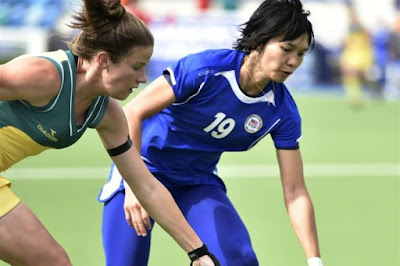
Fazilla, right.
KUALA LUMPUR: National women's midfielder Fazilla Sylvester Silin scored another goal when she graduated as a Fire Superintendent with the Fire and Rescue Department of Malaysia yesterday.
The 30-year-old from Sarawak has played for Malaysia in three Commonwealth Games (2010, 2014 and 2018) and coach K. Dharmaraj only had praise for her.
"She is one amazing las who has exceptional fighting spirit in whatever she makes up her mind to do. I am the least surprised, and very proud of her, for achieving this milestone in her life," said Dharmaraj after his charges lost narrowly 3-2 to India in the Women's Asian Champions Trophy in Donghue, South Korea, yesterday.
Malaysian Hockey Federation (MHC) deputy president Datuk Dr S. Shamala said: "The Malaysian women’s hockey team has very special players and each with their own special ways! One of them is most definitely Fazilla Sylvester more fondly known as Zilla.
"She has sacrificed a great deal the nation, and thanks to the Fire and Rescue Department of Malaysia who has been very supportive and instrumental in allowing Zilla to represent malaysia at the recent Commonwealth Games."
Jugjet's World of Field Hockey
Surbiton 0-2 CDCVD Madrid
Goals from Lucia Tejada and Rebecca Grote guided Club de Campo Villa de Madrid to victory over Surbiton.
Strikes in either half helped Madrid to victory in their opener with Club Cup hosts Surbiton at a packed Sugden Road.
Thousands lined the pitch on a warm evening creating a fantastic atmosphere with plenty of home support for hosts Surbiton.
There was little between the sides in the opening exchanges as both sides felt their way into the contest. The first real attack of the quarter came from the hosts, good work from Jo Hunter saw her dribble to the baseline but her cut back evaded her team mates.
On ten minutes Madrid had their first attack and made it count. A bouncing cut back found Tejada who swept a volley across goal and into the bottom corner after 10 minutes to give Madrid the lead heading into the first break.
The second quarter continued to be closely fought, again Surbiton reached the baseline but this time it was Sarah Haycroft's cross that agonisingly couldn't find a team mate as Madrid kept their lead at half-time.
Surbiton responded well immediately in the second half. Giselle Ansley forced the keeper into a smart save from a penalty corner before another Ansley flick was narrowly missed by Hunter on the left hand post.
Despite plenty of possession and pressure on the Madrid back line the Spanish side took their lead into the final fifteen minutes.
The hosts kept up their work rate and tempo and continued to ask questions of the Madrid defence who kept firm.
With just two minutes remaining Madrid grabbed their second to move out of reach as Grote's drag-flick flew low into the bottom right corner to seal victory.
Next up for Surbiton are HC Victorya Smolevichi tomorrow at 7pm for a place in the EuroHockey Club Cup 5th and 6th place play-off.
Surbiton 0 (0)
Club de Campo Villa de Madrid 2 (1)
England Hockey Board Media release
Surbiton left ‘devastated’ after European exit to Campo De Madrid
By The Hockey Paper
Campo de Madrid’s players celebrate winning their opening game against Surbiton
Surbiton were knocked out at the quarter-final stages of the EuroHockey Club Cup on Thursday night in front of a lively crowd at Sugden Road.
Bidding to reach the semi-finals for the second year running, Brett Garrard’s side were beaten 2-0 by Spanish outfit Club Campo De Madrid.
Lucia Abajo Saenz De Tejada’s stunning volley in the 10th minute proved to bethe crucial difference for the the majority of the game.
Surbiton dug deep as the game wore on with Giselle Ansley and Jo Hunter both going close. Captain Sarah Haycroft, recovering from injury, came on in the later stages as the Londoners produced a wave of attacks.
But the Spaniards sealed the win when Rebecca Grote notched a penalty corner goal with two minutes left.
Haycroft told reporters: “Campo were clinical and it’s disappointing that we dominated possession but couldn’t finish.
“It’s very special to play in front of our home crowd and it’s amazing that so many people turned up.”
Surbiton will now play for a place in the 5th-6th play off match against Victorya Smolevichi of Belarus on Friday night.
Earlier, Amsterdam eased past University College Dublin 8-0, title favourites beat Smolevichi 5-0, while UHC Hamburg edged compatriots Mannheimer 1-0.
FRIDAY
16:45 UCD v MANNHEIMER
19:00 SMOLEVICHI v SURBITON
SEMI-FINALS, SATURDAY
12:00 AMSTERDAM – UHC HAMBURG
14:15 ‘s HERTOGENBOSCH v CLUB DE CAMPO DE MADRID
The Hockey Paper
Top class officials confirmed for EHL FINAL4 in Bloemendaal
To encourage the best club hockey in the world, you need the best umpiring team to create the environment for the players to thrive.
The FINAL4 in HC Bloemendaal on May 26 and 27 will feature a hugely experienced crew of five top class umpires, bringing their experience from the very top level of the game.
England’s Dan Barstow, Poland’s Marcin Grochal, Scotland’s Martin Madden and Spain’s Francisco Vazquez have all been appointed to the World Cup later this year.
They are joined in the team of five umpires by Germany’s Christian Blasch, the 2016 World Umpire of the Year, showing the quality of official on display.
They will be supported by Jakub Mejzlik – a top-line umpire, too, in preparation for the Champions Trophy – in the video booth. The umpires will be managed by Olympic official Rob ten Cate.
Denmark’s Casper Gulbrandsen will be the technical director with support from Christian Deckenbrock as TO and judges Colin Boubert, Michiel Bruning and Michiel Christiaanse.
EHL umpires biographies
Dan Barstow (England) Aged 30
EHL experience
2010 EHL ROUND1 Paris
2010 EHL ROUND1 Eindhoven (NED)
2011 EHL KO16 (KO16) Bloemendaal (NED) VIDEO
2011 EHL ROUND1 Mulheim (GER)
2012 EHL KO16 (KO16) Rotterdam (NED)
2012 EHL ROUND1 East Grinstead (ENG)
2013 EHL KO16 (KO16) Amsterdam (NED)
2015 EHL KO16/FINAL4 Bloemendaal (NED)
2016 EHL FINAL4 Barcelona (ESP)
2016 EHL ROUND1 Banbridge (IRL)
2018 EHL KO16 HC Rotterdam (NED)
International experience
2013 TriFinance EuroHockey Championships Men
2014 Investec London Cup 2014 (ENG) (M)
2014 XX Commonwealth Games 2014 (M)
2016 Uttar Pradesh Hockey Junior World Cup Men Lucknow
2017 Odisha Men's Hockey World League Final Bhubaneswar 2017
Marcin Grochal (Poland) Aged 34
EHL experience
2007 EHL ROUND1 Antwerp (BEL)
2008 EHL ROUND1 Lille (FRA)
2009 EHL KO16 Hamburg (GER)
2009 EHL ROUND1 Paris (FRA)
2010 EHL KO16 Rotterdam (NED)
2010 EHL FINAL4 Amsterdam (NED)
2011 EHL KO16 Bloemendaal (NED)
2011 EHL FINAL4 a Den Haag (NED)
2012 EHL KO16 Rotterdam (NED)
2013 EHL KO16 Amsterdam (NED)
2014 EHL KO16 and FINAL4 Eindhoven (NED)
2016 EHL KO16 Amsterdam (NED)
2016 EHL FINAL4 Barcelona (ESP)
2016 EHL ROUND1 Banbridge (IRL)
2018 EHL KO16 Rotterdam (NED)
International experience
2012 Mens Olympic Games
2013 Sultan Azlan Shah Cup 2013
2013 TriFinance EuroHockey Championships Men
2014 Hero Hockey World League Final
2014 Rabobank Hockey World Cup 2014 (M)
2015 Unibet EuroHockey Championships 2015 (M)
2016 Olympic Games (Men)
2017 Odisha Men's Hockey World League Final
Francisco Vazquez Lopez (Spain) Aged 41
EHL experience
2008 EHL KO16 Barcelona (ESP)
2008 EHL ROUND1 Lille (FRA)
2010 EHL ROUND1 Eindhoven (NED)
2011 EHL KO16 (Bloemendaal (NED)
2012 EHL KO16 (Rotterdam (NED)
2013 EHL FINAL4 Bloemendaal (NED)
2013 EHL ROUND1 Barcelona (ESP)
2014 EHL KO16 and FINAL4 Eindhoven (NED)
2016 EHL KO16 Amsterdam (NED)
2017 EHL KO16 Eindhoven (NED)
2017 EHL FINAL4 Antwerp (BEL)
2018 EHL KO16 Rotterdam (NED)
International experience
2010 ABN AMRO FIH Champions Trophy
2012 Champions Trophy 2012 - Melbourne (M)
2013 Hockey World League Semi-Final - Men
2014 Hockey World Cup 2014 (M)
2014 Hero Champions Trophy 2014 (M)
2015 Pan American Games 2015 (Men)
2016 Olympic Games (Men) Rio de Janeiro (BRA) 2017 Rabo EuroHockey Championship 2017 (M)
Christian Blasch
EHL History
2007 ROUND1 The Hague (NED)
2008 FINAL4 Rotterdam (NED)
2009 KO16 Hamburg (GER)
2009 FINAL4 Rotterdam (NED)
2010 KO16 Rotterdam (NED)
2011 FINAL4 The Hague (NED)
2011 ROUND1 Mulheim (GER)
2012 ROUND1 Barcelona (ESP)
2014 KO16/FINAL4 Eindhoven (NED)
2015 ROUND Hamburg (GER)
2017 FINAL4 Brasschaat (BEL)
International experience
2003 Indoor Hockey World Cup (Men) - Leipzig, Germany
2004 Mens Olympic Games - Athens, Greece
2006 Mens World Cup - Mönchengladbach, Germany
2007 Indoor Hockey World Cup (Men) - Vienna, Austria
2008 WorldHockey Champions Trophy (Men) - Rotterdam, Netherlands
2008 Mens Olympic Games - Beijing, China
2010 Hero Honda FIH World Cup (Men) - New Delhi, India
2012 Mens Olympic Games - London, Great Britain
2014 Rabobank Hockey World Cup 2014 (M) - The Hague, Netherlands
2016 Olympic Games (Men) - Rio de Janeiro (BRA)
Martin Madden
Euro Hockey League
2013 EHL KO16 Amsterdam (NED)
2013 EHL FINAL4 Bloemendaal (NED)
2014 EHL KO16/FINAL4 Eindhoven (NED)
2015 EHL KO16/FINAL4 Bloemendaal (NED)
2016 EHL FINAL4 Barcelona (ESP)
2017 EHL KO16 Eindhoven (NED)
2017 EHL FINAL4 Brasschaat (BEL)
International experience
2012 Champions Trophy Melbourne (AUS)
2013 TriFinance EuroHockey Championships, Boom (BEL)
2014 Rabobank Hockey World Cup 2014, The Hague (NED)
2014 XX Commonwealth Games 2014, Glasgow (SCO)
2015 Unibet EuroHockey Championships, London (ENG)
2016 Olympic Games, Rio de Janeiro (BRA)
2017 Rabo EuroHockey Championship 2017, Amsterdam (NED)
2017 Odisha Men's Hockey World League Final, Bhubaneswar (IND)
Full officials list
Technical Delegate: Casper GULDBRANDSEN (DEN)
Technical Officer: Christian DECKENBROCK (GER)
Judge: Colin BOUBERT (SCO)
Judge: Michiel BRUNING (NED)
Judge: Michiel CHRISTIAANSE (NED)
Media Officer: Stephen FINDLATER (IRL)
Umpires Manager: Rob ten CATE (NED)
Umpire: Dan BARSTOW (ENG)
Umpire: Christian BLASCH (GER)
Umpire: Marcin GROCHAL (POL)
Umpire: Martin MADDEN (SCO)
Umpire: Francisco VAZQUEZ LOPEZ (ESP)
Video Umpire: Jakub MEJZLIK (CZE)
Euro Hockey League media release
2018 AHL Schedule & Details Announced Ahead Of 2019 Revamp
Ben Somerford
Hockey Australia (HA) and the Member Associations are delighted to announce the details of the 2018 Australian Hockey League (AHL) and the range of features being implemented as part of the transition to a new look hockey league in 2019.
The announcement comes following 18 months of consultation, research and testing with the 2018 AHL to be used as a pilot version before the revised league is launched in 2019.
The 2018 AHL will be played throughout October with all States and Territories participating in the competition. The 2018 competition will see States and Territories split into two pools of four, based on the most practical groupings considering travel throughout the first three weeks.
Each team will play three weekends of home-and-away hockey against the other teams in their pool. During these three weeks all States and Territories will host at least one home match which will provide an opportunity to test ticketing to match days, game day activations and hosting requirements (which are planned features of the new league in 2019).
As well, several rule innovations and game modifications will also be introduced and tested during the 2018 AHL, with a view to implementation in the 2019 league.
The fourth weekend will be a finals weekend where all eight Men’s and Women’s teams will travel to a central location and play a final qualifying game, semi finals and finals.
HA are currently negotiating the venue for the finals series and this will be announced in the next month.
HA CEO Matt Favier said: “We are delighted to have formalised the model for the 2018 AHL which provides an ideal pilot competition, with a month-long schedule, fixtures in every State and Territory and rule innovations, as we strive to define our fully revised model for 2019.”
Hockey Victoria CEO Andrew Skillern, who has been a key member of the working group on the AHL project, added: “We are really pleased that we are now able to release the schedule for this year.
“Hockey Australia and all State and Territories have endeavoured to identify the best solution for the sport as whole, with the main idea being for each State and Territory to host at least one AHL home game."
Click here to view the 2018 fixtures
Women’s AHL
Pool A: Western Australia - Diamonds, South Australia - Suns, Northern Territory - Pearls, Victorian Vipers
Pool B: Queensland Scorchers, Canberra Strikers, Tasmanian Van Demons, New South Wales Arrows
Men’s AHL
Pool A: Western Australia - Thundersticks, South Australia - Hotshots, Northern Territory - Stingers, Victorian Vikings
Pool B: Queensland Blades, Canberra Lakers, Tasmanian Tigers, New South Wales Waratahs
The introduction of rule innovations in 2018 are with a view to creating more ‘celebratory moments’ and excitement for the fans.
Favier said: “We want to celebrate what will be the final running of the current, traditional AHL but also test and trial some of the new game innovations that we intend to include in the revised league model for 2019.”
These rules will include:
4 x 12-minute quarters
14 players in the match day squad
A field goal conversion – when a field goal is scored the team will have an automatic one-on-one with the goalkeeper for an extra point
2 x 5-minute PowerPlays – in the last five minutes of the second quarter and the last five minutes of the fourth quarter (details TBC)
No drawn games
Match Points:
5 Points for a win,
2 points to each team in the event of a draw,
A shootout will occur to determine the outright winner
1 point will be awarded to the winner of the shoot-out
0 points to the loser of the match.
Looking to the future, the development of quality and competitive teams across the country is critical to the ongoing success and commercialisation of the competition.
In 2019, talent will be equalised through the introduction of a player draft. South Australia, Tasmania, ACT and Northern Territory will be eligible to select up to four International Players as part of their Men’s and Women’s squads in 2018 as a stepping stone to equalising the quality of the eight teams in the Men’s & Women’s competition 2018.
Click here to view the 2018 fixtures
Hockey Australia media release
Australia Hockey League ushers in one-on-ones and powerplays in revamp
By The Hockey Paper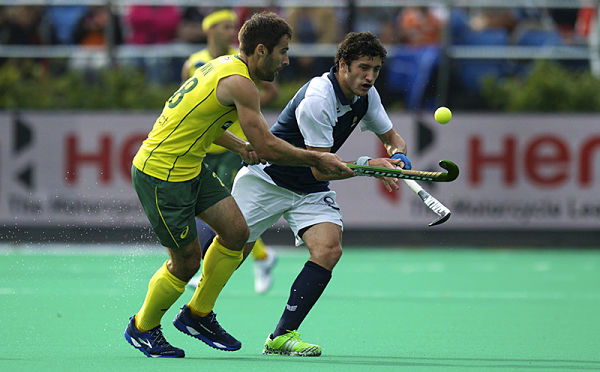
ANTWERP – Hockey World League Semi Final W & M
05 AUS v FRA (Pool A) Photo: MARTIN BRISAC Simon & FFU PRESS AGENCY COPYRIGHT FRANK UIJLENBROEK
There will be more tinkering of the rules, including 12-minute quarters, extra points with one-on-ones with goalkeepers and power plays, when the 2018 Australian Hockey League starts in October.
The men’s and women’s AHL will run across four weekends with home and way fixtures in every state and territory, with the finals slated for October 25-28.
The AHL had delayed revealing details after several stumbling blocks in recent months, while it seems that the 2018 league will be used as a test pilot before a “fully revised” league in 2019.
The 2018 rule innovations include:
4 x 12-minute quarters
14 players in the match day squad
A field goal conversion – when a field goal is scored the team will have an automatic one-on-one with the goalkeeper for an extra point
2 x 5-minute PowerPlays – in the last five minutes of the second quarter and the last five minutes of the fourth quarter (details TBC)
No drawn games
Hockey Australia said that the rule modifications were introduced to produce more “celebratory moments” in the game.
Matt Favier, Hockey Australia’s chief executive, said: “We want to celebrate what will be the final running of the current, traditional AHL but also test and trial some of the new game innovations that we intend to include in the revised league model for 2019.”
Women’s AHL
Pool A: Western Australia – Diamonds, South Australia – Suns, Northern Territory – Pearls, Victorian Vipers
Pool B: Queensland Scorchers, Canberra Strikers, Tasmanian Van Demons, New South Wales Arrows
Men’s AHL
Pool A: Western Australia – Thundersticks, South Australia – Hotshots, Northern Territory – Stingers, Victorian Vikings
Pool B: Queensland Blades, Canberra Lakers, Tasmanian Tigers, New South Wales Waratahs
The Hockey Paper
2018 Field Hockey Canada Nationals: U23 division returns for second year
Nationals will feature a U23 division for the second consecutive year
The 2018 Field Hockey Canada National Championships is taking place July 12-23, 2018 in Toronto, Ontario. The two world-class pitches are located in the heart of the provincial capital on the beautiful campus of University of Toronto. The event will feature three divisions: U15, U18 and U23.
The U23 division is the newest division, being in its second year, and will be played on the final two days of competition. This division is a key part of building our national championships to include all age groups and all our provinces in our national event.
Last year, Ontario won the inaugural women’s U23 tournament in Surrey, BC. They return in full-force looking to defend the title on home soil. Women’s National Team member, Alison Lee, potted a hat trick in the final, contributing to the Ontario victory. According to Lee, the National Championships was a valuable experience for her and her teammates.
“It was great to have the U23 division at nationals last year. It had been a while since there had been an option for university-aged athletes,” Lee said. “It was so fun getting the chance to play with girls who I used to play with throughout university and U18 competitions.”
Lee said that with the many university-aged athletes preparing to return to school in the fall, the tournament provides a great competition outlet. Paul Bundy, the head coach of the Men’s National Team, said this is yet another avenue to be exposed to national team coaches.
“Nationals is a great competition where the national team coaches get to see everyone all in the same place at the same time,” Bundy said. “From our perspective, the U23 division is just another example of trying to make sure we get to see everyone. There are late bloomers, there are players who have suffered from injury and there are players who just missed the age requirements for the junior world cups. We want them all playing in this great competition opportunity.”
Finally, if you’re over 23 this year, you can still play! In order to facilitate growth and development in this division, our 2018 technical regulations allows players one year over aged to play without permission and for players of any age to play with the permission from FHC.
Alison Lee (middle) and her Ontario teammates celebrate a goal at last year’s U23 Nationals in Surrey, BC. Photo/Field Hockey Canada
Field Hockey Canada media release
PSB to build stadium in memory of deceased Olympian Mansoor
ISLAMABAD: The Pakistan Sports Board (PSB) on Thursday announced that it would construct a stadium in Islamabad in the memory of Olympian Mansoor Ahmed, who passed away last week. A meeting of the executive board of the PSB, held here at federal capital, accepted Pakistan Hockey Federation (PHF) secretary general Shahbaz Ahmad Senior’s suggestion to build a stadium after the World Cup winning hockey goalkeeper. The meeting was chaired by Mian Riaz Hussain Pirzada, Federal Minister for Inter Provincial Coordination (IPC). The PSB also decided to provide Rs.01 million to the deceased family and approved recommendation of taking out health insurance for all of its athletes. Ahmed, who was 49, passed away after suffering for weeks from complications stemming from a pacemaker and stents implanted in his heart, and had reached out to India for help in securing a heart transplant.
He had become a sporting icon in Pakistan’s hockey circles after helping the country win the 1994 World Cup in Sydney with his penalty stroke save against the Netherlands in the final. Ahmed played 338 international matches and also participated in three Olympics and various other high-profile events in a career spanning from 1986 to 2000. In addition to being named the world’s best goalkeeper on four occasions, Ahmed was bestowed with a presidential award in 1988 and the Pride of Performance in 1994.
Insurance of sports persons: The PSB will also initiating the process of insurance of sportsmen with the State Life Insurance Corporation of Pakistan. The meeting sanctioned Rs one million to Zarina Waqar, former badminton player and coach who remained under treatment at Shaukat Khanum Cancer Hospital Lahore for the last five years. The meeting approved the creation of post of Project Director for National Sports City (NSC) Narowal and Chief Engineer (Civil) for smooth functioning of the maintenance wing and ongoing development projects. The meeting directed the PSB to call a joint meeting of the IPC Ministry (Sports Wing), PSB, Pakistan Olympic Association (POA) and concerned National Sports Federations to work out the modalities for holding the upcoming South Asian Games in Pakistan.
The committee decided that funds amounting to Rs.500 million should be distributed equally for repair and maintenance of the facilities and amongst the concerned national sports federations to prepare the teams for effective preparation and participation in the South Asian Games.
The Daily Times
Former Olympian Danish Kaleem flays PHF’s ‘bogus’ elections
KARACHI: Former Pakistan Olympian Danish Kaleem has severely criticised the recently held elections of the Pakistan Hockey Federation (PHF), calling the exercise bogus and a violation of fair-game play. “All the complaints submitted by various districts of the country against the election process have remained unheard by PHF election commissioner Chaudhry Mohammad Riaz[yet,” Danish on Thursday. Danish said 19 districts across the country, including 14 from Punjab, were in contact with him complaining against the said elections. “Some districts in Sindh, Khyber Pakhtunkhwa and Balochistan are also raising their voice against the bogus elections in which Sajjad Khokhar and Shahbaz Ahmed Senior were again elected in Islamabad,” he added.
Danish also handed over the list of the districts from across the country, which he said were not satisfied with the election process. Among them were Sahiwal (Danish’s home district), Khanewal, Sheikhupura, Multan, Vehari, Bhakhar, Khushab, Mandi Bahauddin, Islamabad, Bahawalnagar, Kasur, Bahawalpur, Jhang, Rawalpindi, Karachi, Bannu, Mardan, Quetta and Ludhar. “Not even a single hearing was held by election commissioner on our appeals against the PHF elections, and this is a proof how bogus the election process was,” a disgruntled-looking Danish said.
He said despite the fact that the PHF officials – PHF chief Khalid and secretary general Shahbaz – had completed their last term in November 2017 but they continued to work in the PHF, which he termed as illegal. Moreover, the same officials continued their work issuing notifications while the election commissioner was there.
“The same officials Khalid and Shahbaz have again been elected without leaving their ofhces for even one day; this never happened in the PHF history,” he lamented. Danish said his opponents were blaming him as to how he (Danish) while living in Lahore could represent Sahiwal. For their information, for the last two and a half years, PHF secretary Shahbaz has been representing Muzaffargarh while living in Islamabad. Similarly, PHF treasurer Ikhlaq Usmani is from Rawalpindi-Islamabad but now he represents Jhelum. The law should be same for all; Ikhlaq and Shahbaz are no exceptions,” he said.
He said his opponents were also maintaining that coaches should not contest the elections. “I ask then in which capacity Kamran Ashraf and Qamar Ibraheem – coach and manager of Pakistan’s junior team – had contested the PHF elections from their respective districts.” Danish is a coach of the Dar Hockey Academy Lahore, which has produced a number of players for national senior and junior teams. “The PHF is nothing but a ‘family federation’ and the situation explicitly indicates that there is no law to lead the federation,” Danish regretted.
When reminded that Olympian Naveed Alam had moved the Lahore High Court against the 2008 PHF elections but that case was still pending, Danish reckoned the courts were now working faster in giving decisions. “All the districts would get justice, if the PHF does not give any relief. The PHF election commissioner should give all the aggrieved districts at least one chance to plead their cases,” he concluded.
The Daily Times
Depression consumed David Kettle, now he wants sport to do more
Wales hockey goalkeeper opens up about depression
By Dan Roan and Patrick Nathanson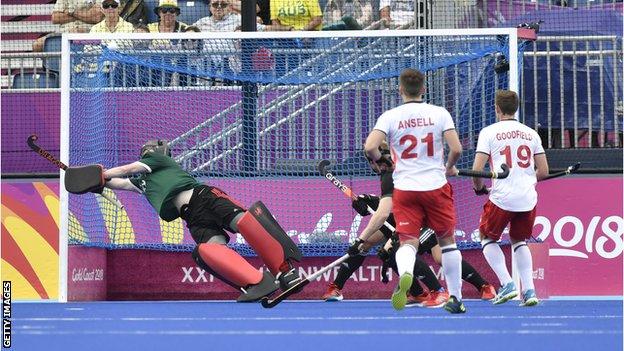
David Kettle makes a spectacular save as Wales lost 3-2 to England during April's Commonwealth Games in Gold Coast, Australia
One of Wales' most capped sportsmen withdrew from international sport last year as his battle with depression worsened, now he is calling for more to be done to help athletes struggling with mental health issues.
In an interview with BBC Sport during World Mental Health Awareness Week, Wales Hockey goalkeeper David Kettle has revealed his own 'relentless' battle with depression and the extent to which it consumed him.
"After the Commonwealth Games in 2014 I realised that something wasn't quite right, I kind of addressed it a little bit through professionals, but just carried on and didn't really seek any help outside of that," he said.
"When it got really bad last year I decided to seek help and I withdrew from international sport. But what I found after that is the support for athletes and coaches and everyone is a bit lacking at the moment."
Kettle, who has captained Wales and is currently on 99 caps, decided to speak out about the support available after his depression became more acute.
"I think everybody wants to help but we don't necessarily know how to help.
"So it's great that more athletes are coming out and talking about it, but I don't think the support around that is probably keeping pace with the athletes that are coming out and talking about it.
"It was pretty bad. For me it was getting quite serious to the point where I wasn't sleeping at all and I was really struggling, if I'm honest.
"I think, yeah, it did get to that point [of having suicidal thoughts]. You don't really know how far it's got until you get to that point and that's probably the point where you think I really need to seek some help here," he continued.
"It was just relentless, absolutely relentless. It just kept coming and kept coming and when you thought it was going away it would come harder and harder and harder and that translated for me into my sleep, I just couldn't sleep at all.
"You do just feel so alone, you feel like no one understands."
'Life and death situation'
Kettle, who represented his country at the recent Commonwealth Games in Australia thinks it is vital that mental wellbeing is talked about alongside the other essential aspects of an athlete's regime.
"I think when we talk about performance and all the components within that, you talk about your strength and conditioning, you talk about your nutrition and your tactical and technical.
"We don't really talk about our wellbeing. And from my experience it's really, really important.
"Wellbeing can be a life and death situation but I don't think it's really considered as important at the moment as other aspects of performance.
"I think it will get there but in my experience, it's not at the moment.
"Mental health is quite complicated, it is quite difficult to understand and I think the more support that can be given to coaches, to athletes, to National Governing Bodies, I think the better.
"Whether it's financial importance or front of mind, whatever it is I think it should be given more airtime and consideration.
"I think it will get there but in my experience, it's not at the moment."
Kettle also believes that common assumptions around the causes of depression need to be addressed.
"I was working at a pretty high-pressured job, competing at an elite level, I was captain of my country, all the usual triggers that you associate with depression, I didn't have. I was financially stable, good friends, good family, it was something a lot deeper than that," he said.
"What was frustrating was that when I actually did come out and talk about it, because of the lack of understanding, people just took that as you can't handle the pressure or you can't handle the stress."
'Macho environment'
In a week in which a UK Sport report revealed that nearly a quarter (24%) of British athletes said they were dissatisfied or very dissatisfied with the "measures taken in their sport to optimise the mental health" of high-performance athletes, Kettle hopes that by talking about his experiences he will further highlight the issue and spur others to seek help.
"I'd really encourage them to speak to someone, that's the most powerful thing I've done," he said.
"You'll be surprised how many people have had similar feelings or been through something similar or know someone, so the support I received from my teammates afterwards was absolutely incredible and a real source of strength and that for me was the best thing I've ever done, to open up and talk to them.
"If you're struggling, don't be ashamed, its nothing to be ashamed of, and really try and speak to someone.
"I think sport inherently probably doesn't encourage people to come out and talk about it. It's definitely getting better but I think the nature of it is... quite a macho environment. I think it is quite difficult at the moment."
'Buddy system'
Being one of a growing number of sportsmen and women to have publicly discussed their own struggles with mental health, one initiative Kettle would like to see is the implementation of a pan-sport 'buddy system,' with the aim of creating a mental wellbeing support network involving former and current athletes.
"I really benefitted from speaking to another athlete who had been through something very similar and I think its obviously great that athletes are coming out and talking about it now," he said.
"I think if we could make those athletes accessible to people who may be struggling, I think that would be really powerful. I love this idea of fraternity and community.
"It consumes you, it absolutely consumes you. The more you fight it yourself, the more it consumes you, it just takes up all of your energy.
"The only way you can break that cycle is by speaking to people and acknowledging in yourself that you are struggling and there's nothing wrong with doing that."
BBC Sports
FIH agrees global digital partnership with award-winning Little Dot Studios
The International Hockey Federation (FIH) has agreed a two year partnership with award-winning digital media company Little Dot Studios which will see them amplify the organisation’s content creation and distribution across digital platforms.
With offices in London, Los Angeles, Munich and Buenos Aires, Little Dot Studios are one of the fastest growing next-generation media companies, managing YouTube channels and social video for over 150 global TV brands, broadcasters and sports rights holders. The Little Dot portfolio includes The Graham Norton Show and Gordon Ramsay, Discovery, Channel 4 and ITV, as well as Formula E, the ECB and The (English) Football Association. They have also launched several award-winning branded campaigns, all of which has established them as one of the world’s leading digital agencies.
"This partnership represents a step change in the way we approach our digital broadcast strategy."
FIH TV and Broadcast Director, Andy Oram
For the first time in the FIH’s history, hockey content will be activated on a global scale by Little Dot Studios’ team of industry experts. By using thousands of hours of content, they will amplify the sport’s reach by celebrating hockey’s rich history and bringing to life the stories that make the modern game one of the world’s most inspiring sports. This content will be crucial to maximising engagement in hockey’s flagship events taking place later this year - the Hockey World Cups and Hockey Champions Trophies.
Speaking about this, FIH TV and Broadcast Director, Andy Oram, said: “This partnership with Little Dot Studios represents a step change in the way we approach our digital broadcast strategy and the importance of leveraging our own channels. For the first time our content will be amplified to a global audience through the expertise and creativity provided by Little Dot Studios. By increasing engagement in our content and subsequently our reach across FIH digital channels, this partnership represents a crucial component of our Hockey Revolution strategy’s aim of generating millions more followers across the world.”
In addition, Little Dot Studios Managing Director, Wayne Davison, said: “We’re thrilled to be working with one of the planet’s most action-packed sports at a very exciting time for the game. Hockey has an exceptionally compelling story to tell, whether through the skills and athleticism of the players on the field, to the unique and inspiring characters off it. The FIH are looking to the future of the sport and, together, we have the opportunity to deliver the very best content for both hockey’s loyal followers and millions more sports fans globally, who, our experience shows, will love this truly dynamic sport.”
About Little Dot Studios
Little Dot Studios is one of the fastest growing next generation media companies, managing over 150 YouTube channels and Facebook pages, as well as social video content for global sport and TV brands. Little Dot Studios works with sports partners such as the FIA for Formula E, The FA, England & Wales Cricket Board, Eurosport, Mo Farah, ITV for live clipping of Euro 2014 and the World Cup 2018, and Channel 4 for the Paralympics. Little Dot Studios also has partnerships with over 120 independent production companies, brand owners and broadcasters including ITV, Channel 4, Viacom, Cartoon Network and Discovery. In addition, Little Dot Studios is also one of the biggest producers of digital original video developing and creating content for broadcasters and brands such as Porsche, Samsung, Pepsi and Honda. Visit www.littledotstudios.com
FIH site